


Typically, over the course of a K–12 career, a student goes to school, or is supposed to go to school, about 2,340 days. Naturally, missing significant portions of time can mean graduating without essential skills. When thinking about a student’s education, most people do not think of it holistically. Yet, those many days of consistent learning each year provide structure for mastering grade-level standards and building literacy, numeracy, and problem-solving skills. Missing extensive periods of that time creates gaps that accumulate throughout a student’s academic career. In my experience as a teacher, principal, and district administrator, I have seen firsthand how missing school – and missing often – can derail a student’s ability to be successful in school.
In most states, students are expected to attend school for approximately 180 days each year. Thirty-one states and the District of Columbia set a minimum of 180 days in statute, and many others employ similar equivalent instructional-hour requirements. School days account for nearly half of each year. Thus, each school day is crucial. Yet chronic absenteeism has surged since the pandemic. The U.S. Department of Education reports that 28% of students were chronically absent in 2022–23. “Chronic” is defined as missing at least 10 percent of the school year for any reason, or roughly 18 or more days out of the180 day school year.
Clearly, chronic absenteeism has a substantial impact on learning. However, school attendance not only impacts a student academically but also socially and emotionally. Attending school regularly requires punctuality, persistence, and responsibility. Daily contact with classmates and caring adults strengthens motivation and promotes a sense of well-being and belonging. Attending school regularly helps create a predictable environment, which fosters emotional security and focus. Students also have access to meals, health and counseling services, and enrichment activities.
The figure below shows how missing different numbers of days each year accumulates over a student’s full K–12 career.
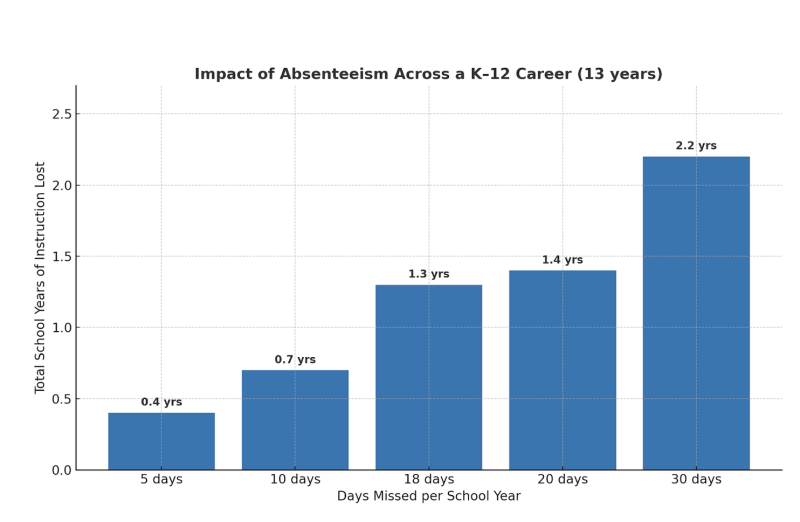
As can be seen, over the course of a K-12 career, 90% attendance (i.e., being absent 10% of the time, the chronic absence threshold) equals about 1.3 years lost. Missing 30 days per year – an attendance rate of about 83% – equals about 2.2 years lost over a 13-year period. National Attendance Awareness Month is a national campaign devoted to combating chronic absenteeism, and the Attendance Awareness Campaign (AAC) is one of the most significant national resources partnering with states to improve student attendance. While September is Attendance Awareness Month, improving attendance is a year-round campaign, and these efforts are often redoubled as the second semester begins. School days are not just days on a calendar. Every day a student is in school is an opportunity to learn, build relationships, and access support (https://awareness.attendanceworks.org). For more information about this topic, see the August 2025 Equity Exchange article, Chronic Absenteeism, Engagement, and a Sense of Belonging.