

The 2026 Winter Olympics in Milan-Cortina have just ended, baseball’s spring training is in full swing, and the annual NCAA college basketball tournament, March Madness as it is often called, is just around the corner. It is an exciting time for sports fans – and K-12 students are no different. In our public schools, athletics also play an important role because they offer many students opportunities to be part of a team and to feel valued and respected by their peers, teachers, and school community. Whether through PE classes, informal intramural sports, or formal athletic teams, schools use physical activity to help students stay healthy, engaged, and connected to school.
Still, for our children, March is only one month, and physical activity is only one dimension of health and wellness within a whole-child approach.
For decades, researchers have sounded the alarm for more balance and less testing. Darling-Hammond and Cook-Harvey (2018) argue that, because of the focus on test-based accountability, many U.S. schools have become less attentive to the “broader life skills” students need and to the “sense of self” required to achieve their full potential. Noddings (2005) takes a more optimistic view but cautions that as schools become more focused on the whole child, “the temptation arises to describe the whole in terms of collective parts and to make sure that every aspect, part, or attribute is somehow ‘covered’ in the curriculum.” Instead, he argues that “we must allow teachers and students to interact as whole persons, and we must develop policies that treat the school as a whole community.” Similarly, Comer’s framework emphasizes that “children need positive interactions with adults in order to develop adequately” (Comer, 1996).
Noddings and Comer are certainly correct. Yet we also know that school curricula and programs play critical roles in nurturing and supporting the whole child. For example, almost all elementary schools offer some level of art and music experiences for children (Dalane, 2024), and these co-curricular subjects provide enjoyable, engaging opportunities for children whose interests and talents extend beyond the core curriculum. Similarly, nearly all middle and high schools offer art and music classes and often have a school band, orchestra, dance team, and/or chorus for students to join.
During my time as superintendent in Austin, Texas, our partners at Any Given Child would reference a compelling study conducted about arts in the state. Of art and music offerings in Texas, Thomas et al. (2013) found that 98% of schools offered at least one course in music and 97% offered at least one course in visual art, with theatre (89%) more common than dance (47%). Looking nationally a decade earlier, NCES reported that 91% of U.S. public high schools offered music in 2009-10 and 89% offered visual arts (Parsad & Spiegelman, 2012). More recent national data show a similar overall pattern, with important gaps by discipline and context. Drawing on the November 2024 School Pulse Panel survey, the National Endowment for the Arts (2024) reported that 93% of public schools offered at least one standalone arts class during the regular school day, with music (84%) and visual arts (82%) most common; media arts (42%), drama/theater (26%), and dance (13%) were far less prevalent. The same analysis found that access varies by school size, grade level, student demographics, and neighborhood poverty levels, underscoring that availability is not evenly distributed (National Endowment for the Arts, 2024). These patterns echo peer-reviewed findings that school size is among the strongest predictors of arts course availability and that higher concentrations of students eligible for free or reduced-price lunch are associated with reduced availability (Elpus, 2022). Policy expectations also remain uneven. ArtScan’s 2025 update reports that nine states have no arts requirement for high school graduation, while other states require arts credits, provide arts-credit alternatives, or both (Arts Education Partnership, 2025).
To support students’ diverse interests and talents, in the large urban districts where I served as superintendent, parents and proponents of whole child development advocated that the district provide a range of curricular, co-curricular, and programmatic opportunities and resources, including music, art, dance, world languages, dual-language programs, STEM/STEAM, science and technology fairs, read-a-thons, and before- and after-school activities and clubs. I agree strongly with that position. Further, to support learning beyond the school day, providing hotspots, tablets, and/or laptops to every child who needed them, along with hundreds of educational software tools and applications for use both in school and at home, helped support academics and arts as well.
Supporting the whole child also requires explicit attention to students’ mental and physical health. Our systemwide strategies included a districtwide SEL implementation, a partnership with the Anti-Defamation League to launch a No Place for Hate (NPFH) initiative, and a range of mental and physical health wraparound services. SEL was implemented in partnership with the Collaborative for Academic, Social, and Emotional Learning (CASEL) and school leadership teams to ensure it aligned with instruction rather than competing with it. Hundreds of staff members became certified Restorative Practices trainers and, recognizing that supporting the whole child also requires supporting the whole adult, the district delivered adult SEL training on self-care, self-awareness, and self-management to staff across schools and departments.
Over five years, through ongoing support and consistent practice, SEL became fully integrated into instruction. And, as Noddings suggests, students’ lives do not neatly fit into categories, so in our districts, SEL was intentionally connected to wraparound services. Partnerships were formed to provide eye exams and glasses; support families experiencing homelessness; expand behavioral and mental health supports; provide trauma-informed and mental health first aid training for teachers; and implement targeted interventions to reduce suspensions and strengthen support for vulnerable student populations. These efforts resulted in the opening and expansion of school-based health and dental clinics, asthma van services, telehealth services, immunization drives, and vision screenings across the district.
Here in Maryland, the Maryland Department of Education has adopted the Whole School, Whole Community, Whole Child (WSCC) framework developed by the CDC and ASCD. According to the CDC, the WSCC model shifts the focus from academic outcomes alone to the development of the whole child. The model centers on the child and emphasizes a coordinated approach in which schools, families, and communities work together (see the figure below). It is hoped that this alignment and collaboration will create safe, supportive, engaging, and equitable learning environments, reduce barriers to learning, and promote healthy behaviors. By fostering partnerships among educators, health professionals, families, and community organizations, the model helps schools build sustainable practices that enhance student well-being, improve educational outcomes, and strengthen communities.
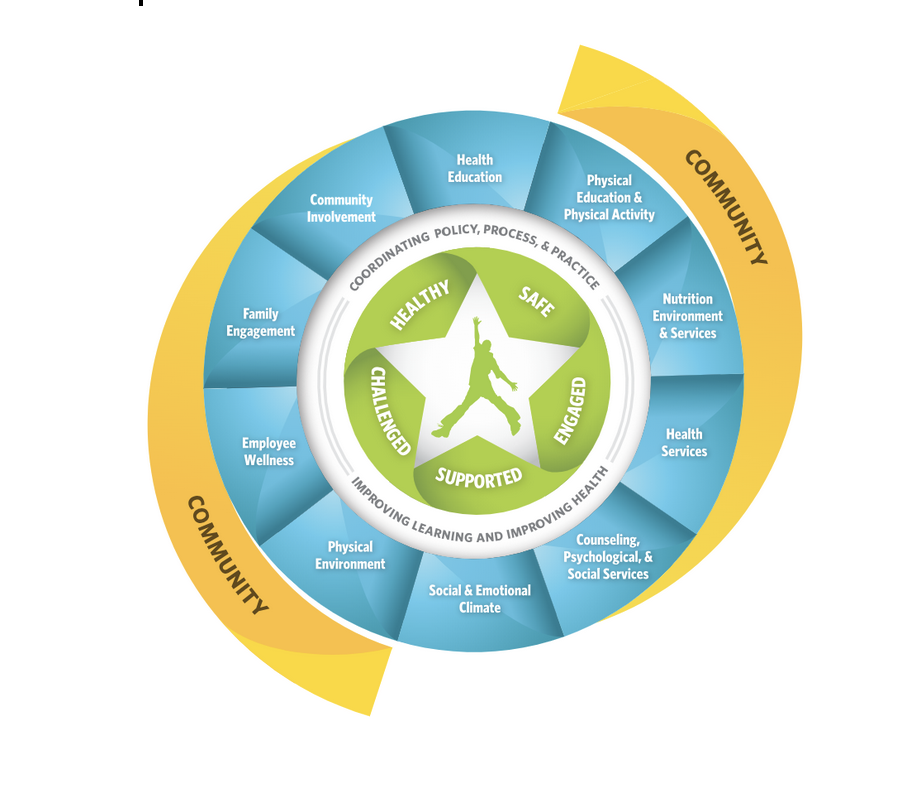
Source: CDC, 2024, Whole School, Whole Community, Whole Child (WSCC).
Of the ten components, I believe the social and emotional climate of a school creates the foundation for the other nine. As Darling-Hammond and Cook-Harvey (2018) observed, “Educators’ abilities to forge strong relationships with students lie at the heart of strong schools.” This reflects what both Noddings and Comer have emphasized about relationships and community.
Children learn when they feel safe and supported, and their learning is impaired when they are fearful, traumatized, or overcome with emotion. Thus, children need both supportive environments and well-developed abilities to manage stress and cope with the inevitable conflicts and frustrations of school and life beyond school (Darling-Hammond & Cook-Harvey, 2018; Vogel & Schwabe, 2016).
According to the National School Climate Council, “School climate is based on patterns of students’, parents’ and school personnel’s experience of school life and reflects norms, goals, values, interpersonal relationships, teaching and learning practices, and organizational structures” (National School Climate Council, n.d.). Sadly, studies show that the majority of middle and high school students do not feel that their school provided a caring, encouraging environment (Darling-Hammond & Cook-Harvey, 2018). Furthermore, researchers report that studies have consistently identified differences among White students and students of color in their perceptions of school climate, with youth of color perceiving less positive school climate experiences, for example, less favorable experiences of safety, connectedness, relationships with adults, and opportunities for participation, in comparison to their White peers.
At the same time, research points to what is possible when schools invest intentionally in climate and relationships. An analysis of 78 school climate studies published since 2000 found that a positive school climate can mitigate the negative effects of poverty on academic achievement. The authors conclude that a more positive school climate is related to improved academic achievement beyond the expected level of achievement based on student and school socioeconomic backgrounds. The most important school climate elements contributing to increased achievement were teacher-student relationships, including warmth, acceptance, and teacher support (Berkowitz et al., 2016).
Another extensive review of 327 school climate studies found that the most successful schools empower educators with the flexibility, support, and opportunities to implement practices tailored to students’ unique needs (Wang & Degol, 2016). Based on these studies, Darling-Hammond and Cook-Harvey (2018) proposed a Framework for Whole Child Education.
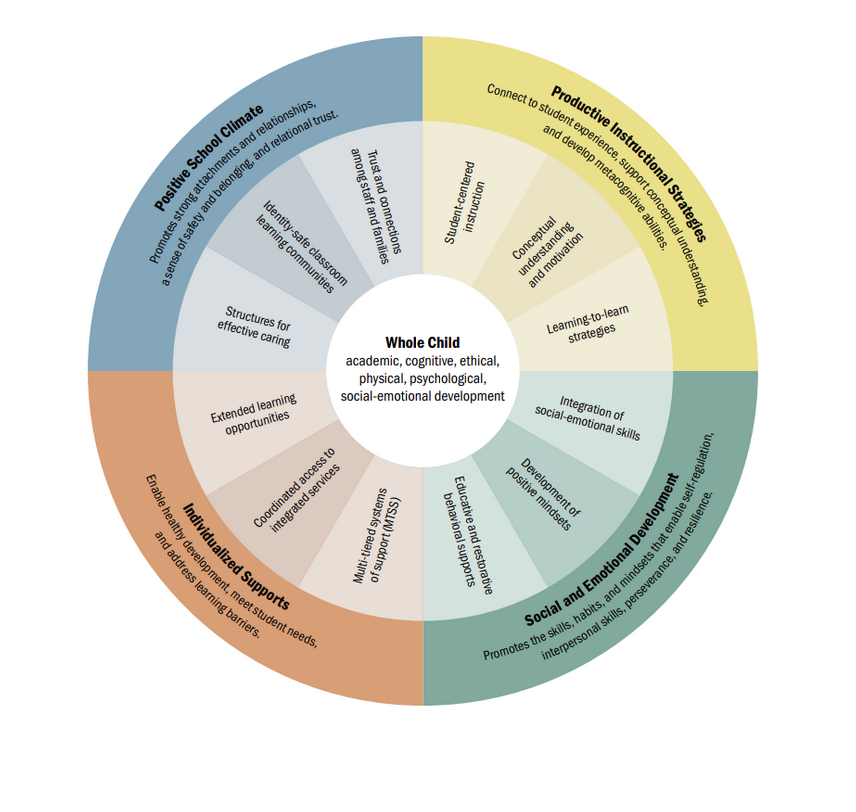
Even our smallest urban schools typically serve hundreds of children. Given the complexity and scope of the issues schools face each day, it is no wonder teachers and administrators often feel overwhelmed. Educating the whole child goes far beyond athletics or any single program. Schools that truly support the whole child build caring communities where students and adults interact as whole people, not as collections of isolated skills or needs. Strong, trusting relationships between students and adults are the foundation of learning.
At the same time, curricula and programs, such as extracurricular activities, arts, music, language learning, STEM/STEAM, counseling, and culturally responsive programming, play a critical role in providing equitable opportunities for students with diverse interests and talents. Whole-child strategies must also include access to technology, comprehensive social-emotional learning (SEL), restorative practices, adult SEL, and robust wraparound services. This work should be aligned with the CDC/ASCD Whole School, Whole Community, Whole Child (WSCC) framework, which emphasizes collaboration and coordination among schools, families, and communities.
Still, the heart of this work is a caring, stable, and safe social and emotional school climate. A positive school climate is not optional; it is essential. Research shows that a positive school climate, especially strong, supportive teacher-student relationships, improves academic, behavioral, and social outcomes and can mitigate the effects of poverty. Yet the research also highlights persistent inequities, as students of color often experience school climate less positively than their White peers, reinforcing the need for intentional, equity-focused, whole-child approaches.
These issues are central to the work and research conducted by the NCEED staff and faculty. Justice and equity are the foundation of NCEED’s six pillars (https://nceed.morgan.edu/) as we work with partners in Maryland and nationwide to address the most critical issues facing students, parents, communities, teachers, and administrators. Only by addressing the whole child can we overcome the disadvantages and inequities our most underserved children face.
In this month’s edition of the Equity Express, Bill Caritj’s Numbers That Matter article, “Whole Child, Equity, and Student Outcomes,” goes deeper into whole-child data and issues of equity. In addition, Dr. Afiya Fredericks (Associate Professor of Advanced Studies, Leadership, and Policy and NCEED Research Faculty at Morgan State University) explores the critical importance of mindset across multiple levels (i.e., individual, interpersonal, and cultural) in her article titled “Beyond Individual Beliefs: Rethinking Mindset, Culture, and the Responsibility to Build Cultures of Growth.”
References
Anna, A. (2016). Musical activities as a stimulating tool for effective early years education of a whole child. International Journal of Education and Research, 4(5), 53-64.
Arts Education Partnership. (2025). 2025 Highlighting State Arts Education Policies: Arts Requirements for High School Graduation. https://www.aep-arts.org/wp-content/uploads/ArtScan-2025-High-School-Graduation.pdf
Berkowitz, R., Moore, H., Astor, R. A., & Benbenishty, R. (2016). A research synthesis of the associations between socioeconomic background, inequality, school climate, and academic achievement. Review of Educational Research, 87(2), 425-469.
CASEL. (2018). History. https://casel.org/about-us/our-history/
Centers for Disease Control and Prevention. (2024). Whole School, Whole Community, Whole Child (WSCC). https://www.cdc.gov/whole-school-community-child/about/index.html
Chiang, R. J., Meagher, W., & Slade, S. (2015). How the Whole School, Whole Community, Whole Child model works: Creating greater alignment, integration, and collaboration between health and education. Journal of School Health, 85(11), 775-784.
Comer, J. P. (Ed.). (1996). Rallying the whole village: The Comer process for reforming education. Teachers College Press.
Dalane, K. (2024). Trends in arts education in United States public schools from 1988-2018. Arts Education Policy Review, 125(4), 328-340.
Darling-Hammond, L., & Cook-Harvey, C. M. (2018). Educating the whole child: Improving school climate to support student success. Learning Policy Institute.
Darling-Hammond, L., & DePaoli, J. (2020). Why school climate matters and what can be done to improve it. State Education Standard, 20(2), 7.
Elpus, K. (2022). Access to arts education in America: The availability of visual art, music, dance, and theater courses in U.S. high schools. Arts Education Policy Review, 123(2), 50-69.
Maryland State Department of Education. (n.d.). Using the Whole School, Whole Community, Whole Child Model to support mental health in schools. https://marylandpublicschools.org/about/Documents/MSSHC/UsingWholeSchoolWholeCommunityWholeChildModelSupportMentalHealth%20inSchools3.5.23.pdf
National Endowment for the Arts. (2024). Arts education in U.S. public schools: Insights from the November 2024 School Pulse Panel Survey. https://www.arts.gov/sites/default/files/SchoolPulseSurvey_final.pdf
National School Climate Council. (n.d.). What is school climate, and why is it important? https://schoolclimate.org/school-climate/
National Scientific Council on the Developing Child. (2010). Persistent fear and anxiety can affect young children’s learning and development (Working Paper No. 9). https://developingchild.harvard.edu/
Noddings, N. (2005). What does it mean to educate the whole child? Educational Leadership, 63(1), 8-13.
Parsad, B., & Spiegelman, M. (2012). Arts education in public elementary and secondary schools: 1999-2000 and 2009-10 (NCES 2012-014). National Center for Education Statistics, Institute of Education Sciences, U.S. Department of Education, Washington, DC.
Thomas, K. M., Singh, P., Klopfenstein, K., & Henry, C. T. (2013). Access to high school arts education: Why student participation matters as much as course availability. Education Policy Analysis Archives, 21(74).
Vogel, S., & Schwabe, L. (2016). Learning and memory under stress: Implications for the classroom. Science of Learning, 1, 16011.
Wang, M., & Degol, J. (2016). School climate: A review of the construct, measurement, and impact on student outcomes. Educational Psychology Review, 28(2), 315-352.